Showing posts with label New York. Show all posts

Monday, 7 January 2019

Autistic Artists: Exploring Limitations and their Impact


On my quest to meet with as many autistic artists as possible in NYC, I’ve opened myself up to speaking with writers, filmmakers, poets, musicians – and even those that have worked alongside autistic artists to create TV and media content. There are many trends that are coming through, and for me this is summed up in the following two points:

- The talent is there
- But so are the struggles

It’s all very simple. I’ve seen some incredible paintings; those of the most intricate of detail, as well as the loosest of abstract form, beautiful verses of prose and the most moving of narratives, musicians playing pure goosebump-inducing melodies, and then there’s the incredibly impactful and compelling short films and documentaries I’ve seen produced. I feel the defining factor and difference is that these are all people with a powerful drive and passion; that they’re putting their energy and soul into the projects they’re working on – and you can feel this very tangibly.

Obviously, I’m realistic though – there’s a heap of talent in New York. It’s a congregation of some of the world’s greatest arts talent in one giant city. And that’s quite scary to think about!

But the struggles are definitely evident, and everyone has their own bag of what they’re dealing with. However, it’s more the impact that these struggles then have on one’s art practise. So, for instance, I met a visual fine artist who struggles with sensory overload and consequently finds it hard to visit galleries. This then means that they can only visit them in small doses, and has to undertake more visits to be up-date-to-date with the current art scene. Another fine artist has social difficulties and struggles with multiple conversations taking place at the same time. Sadly, he can’t attend any private views and openings due to the feeling of overwhelm - and has to leave – in case he has a meltdown. This means that he misses out on meeting with and networking with artists, gallerists, curators – and other crucial connections. Another writer has a massive anxiety about using public transport and struggles to meet others within her community of writers and attend workshops around the city.

Maybelline Gonzalez and her work, Instagram: @msmaybellene 

There are many, many examples I can give you of difficulties people on the spectrum face and the consequent impact and limitations it can have on one’s career - especially in a job where you need to be doing more than simply fine-tuning your craft. You have to be communicating and getting your work out there for it to be seen and known. And that in itself is a serious undertaking of will that all artists find challenging.

David Savette’s painting ‘Scent of Comfort in the Rain’, Instagram: @talldarkpoetny

The ultimate factor that stood out for me though was the barrier to employment – virtually all artists I met with had some type of difficulty in holding down a regular job. Each of these artists had had some kind of difficulty – or simply very bad experiences, in the past. With creative jobs or otherwise. Even though they’re all tremendously talented, and employers are open to disabilities and diversity, there is this expectation of employers (regardless of whether they’re an arts centre or theatre) - that you need to be turning up each day, and performing your role, diligently. This is a real challenge and I’ve heard countless stories of artists who haven’t been able to make this work. Our condition leaves us unable to perform stably all the time. And this makes it tough if you wish to subsidise your artistic income, which you undoubtedly are likely to have to do. This may leave you dependent on others, including the State. I know of an artist currently struggling to find a roof over her head. And that’s very sad.

Larry Bissonnette – autism advocate and artist based in Vermont 

And then what? What’s next for these artists?

I mean, I am meeting people who have managed to make it work. I met one artist for example who works at a school with special needs students, namely autistic ones, and then works on his art outside of this. This is a success story. And I’m really stressing that point. He gets to do both. He’s found a job he enjoys and cares about, while still leaving him with enough time to work on his art and make a living. He even volunteers with young autistic people at the weekend in the arts!

Some autistic artists who have more complex and severe needs may gain the support of an art centre that operates as a day care centre and are helped and supported in this form. Such places are often funded through Medicare, i.e. the Government, and will provide space and support where artists can produce art, and then the organisation will have connections with galleries, corporations and other means to sell and exhibit their work. I’ve written about these spaces in my other blog ‘Art Spaces Supporting Autistic Artists in NYC’, and for those who can get on such a programme (spaces are often very limited), it can be very beneficial – simply because of the artistic links that these centres have.
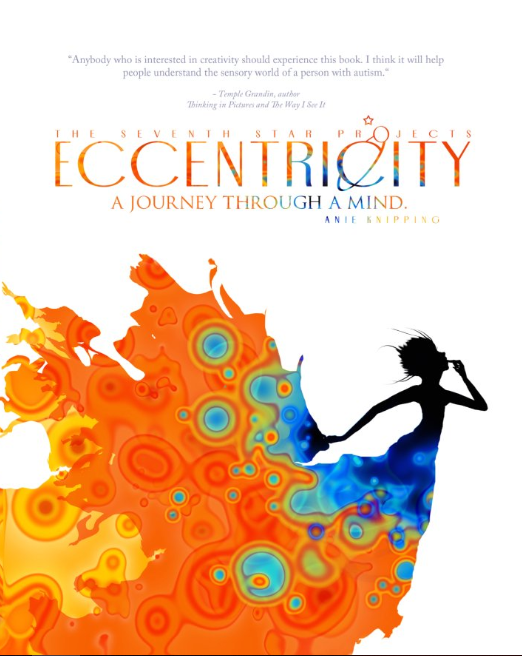
Anie Knipping's incredible book about her autism and life journey: ‘Eccentricity: A Journey through a Mind’ 

But it raises the question as to what becomes of these ‘middling’ autistic artists. Those artists whose needs may not be seen as severe enough to be State supported, yet they still struggle on in their own way. And I don’t have the answer to that! I know I regularly struggle with my autism and that can limit me, yet I also feel that I’m finding ways to make it work. Little by little. Perhaps it’s a lifetime’s worth of exploration and figuring out, who knows. But the point here is to raise awareness of these artists.

So what does ultimately become of these people? Do they continue to pursue their art? Does it simply take them a lot longer to ‘get there’? Do they have to resort to job-after-job of which may or may not work out…? My personal view is that things often haven’t been easy for us (I’m not saying everyone else has had it easy), and I therefore feel we have a higher degree of resilience than the average person, and will therefore make it work out - somehow.

Please help me complete the picture, by contacting me and sharing your stories. And I guess to an extent, only time will tell of what becomes of neurodiverse artists. But let’s not wait that long ;D!

Saturday, 22 December 2018

Actionplay: Striving to Build a More Inclusive World!


I had the joy of being invited to see Actionplay - in Action - quite literally recently. It was for one of their AIMS workshops, which consists of around twenty teens and young adults (13-22 years), on the autistic spectrum (and related conditions), to come along and be part of a 90-minute drama-impro workshop in central Manhattan. The goal of the workshop programme? To encourage greater confidence and increase communication and social skills among attendees.

Based in New York City, Actionplay is a non-profit dedicated to providing children, teens, and adults on the autism spectrum and related conditions equal access to education, arts and culture. Their programmes are open to the general public, and involve creative learning environments, professional development, and training modules to those on the spectrum to experience the arts.

I’d been in touch with Aaron Feinstein, their Executive Director and Founder, a few times and he suggested that the best way to see what they get up to is to come along to one of their sessions. I couldn’t agree more! So there I was, Sunday morning, getting off at Penn Street station and strolling down to the mid-town rehearsal space, not quite knowing what to expect… But intrigued and excited all the same.

Initially, I thought I’d be the ‘quiet observer’ on the periphery - but could not have been more wrong. From the outset I was involved in the warm-up tasks; completely out of my depth as I couldn’t remember the last time I’d even expressed myself in terms of shapes, sounds and movement via my body. It really took me away from my mind though; a place that I’m sure many adults can relate living their lives from. The respite was astonishing. But more so was what was going on around me: the teens and young adults’ enthusiasm and appetite for getting involved. And then there was the talent! These kids were really good. I also found them to be very respectful towards one another – listening well to each other, being quiet when someone else was performing.


The tasks built up in momentum slowly, as the participants got more into them. Music aided these exercises, with Gabriel Lit on the piano entwining apt melodies with the movements. The activities were varied and involved anything from passing a sound around the room in a circle, and adding your own - to giving a 30-second pitch of their ideas for the future Actionplay concert. This latter task was then followed up with the group being split into two, and one idea being picked by each group – creating a five-minute rendition of what the show could look like. Ideas were formulated and explored, people were free to express themselves within the context of the exercises – and most importantly; fun was had and there was a great sense of buoyancy.

And I know that this was all a direct reflection from Aaron and his incredible team of staff and volunteers. There was approximately one staff member to every two/three participants. What I noticed was how dedicated, enthusiastic and compassionate they all were. They would turn up half an hour before the session to ensure careful planning and addressing any updates, while another half hour was given after the session to discuss any issues within the session and to then wrap up and look forward to future sessions. The volunteers came from all backgrounds including teaching and the arts, but the real thing that stood them apart was their passion for accessibility to the arts and their genuine desire to be helping these individuals in obtaining this.

What struck me the most was having this space and programme available, full stop. These teens and young adults have a place to go where they channel themselves, develop themselves and be with others on the spectrum – and to ultimately do something that they enjoy.


It was wonderful and a true eye-opener to attend the workshop. The most surreal thing was that I could tell that each and every person wanted to be there, and there was this real tangible buzz of energy – a great force of positivity, power and intent of creative endeavours. Amazing…

How did I feel after? Well I was quite exhausted and exhilarated – and both in equal measures. Shattered because it was such an intense period of high-intense activity, with different things happening all around – but exhilarated because it was all so thrilling to witness. Exciting in that there was this amazing opportunity for those on the spectrum to come and be a part of – that they could be alongside staff and volunteers who are tremendous, inclusive-centric and truly able to support them. How incredible 😊


A big thanks to Aaron and the team for letting me take part in one of Actionplay’s workshops! Find out more about them on their website: http://actionplay.org/

Tuesday, 27 November 2018

Women and Autism - My Musings


Diagnosed with Asperger’s syndrome (an Autism Spectrum Disorder) three years ago, I chose to embark on a collaborative art project to explore the issues around ‘women and autism’, which I’ve covered here in ‘Women and Autism - A Collaborative Artistic Partnership’. As I’ve learnt more about the condition over the years, I’ve noticed considerable gender differences in perceptions of autism; its presentation and coping strategies between men and women – to the point where women are often misdiagnosed or undiagnosed with autism. I’ve questioned this considerably and the reasons behind it. I feel there’s certainly an increase in recognition in this field of thought, especially from those already with a fair degree of autism awareness - but not so much beyond it. For beyond it still lies a more outdated and stereotypical image of the autistic male. An update and restart are needed.

I’ve summarised my musings in my exploration to consider and understand issues around ‘women and autism’ in a piece of creative writing, with the text transcribed out below the image.


“Men. Why is autism so different in men than in women? Or is it…? Why is the male ‘form’ the accepted norm? the one where people have this ‘aha’ moment and realise that ‘yes sure, I’ve heard of this Autism business!’ and they revert back to TV shows and films. ‘Atypical’ and What’s eating Gilbert Grape’. The media conveying a one-sided view of what is. And-how-it-is. And yet missing out on what oh-so-isn’t… why is Autism so much more apparent and ‘obvious’ in men? We have a subtler presentation they say. But the most dismissive comment of all: ‘Oooh, but you don’t look (how does one look autistic anyway?) autistic.’ How dare you. a compliment you meant? Oh. I’m sorry. I didn’t realise that disregarding who I am and my total being is a compliment. For ‘so what’ if I’m autistic? Poor me…? An all cast set of male actors. Who are unlikely autistic, playing autistic men. In Science, Maths, Psychology. Historically. White men. All making inferences, studies, research, analysis – on Autism. What could they know? Or wish to consider about in female autistics? ‘Autism is Autism’ they say. Why are we misdiagnosed? Misunderstood. Undiagnosed. Why are we still playing catch-up with men? Every field. Yes, it’s unfair, blah, yes. But it’s not a whining point. If women are not being diagnosed, or misdiagnosed, their Autism is not being picked up on. Then this is a very serious point. And a subtler ‘presentation’ doesn’t mean we’re not struggling. That it’s not valid. That it’s less of an issue. That we can somehow seamlessly cope with it, because ‘we don’t look it’! We’re often over-compensating. And that’s hard work! The exhaustion, harshness, loudness, brightness. We feel this. Separate. A cultural gap. Initially misinterpreted as shy. Because women are more likely, at a societal level, to be considered shy… Bollocks. Gender differences. I am of course more than a label. More. But at the same time, this label can be helpful: liberating and empowering. And autistic women shouldn’t be left out here. Leave no-one behind they say. Well mean it.”

And it’s not just ‘women and autism’ that is the issue here either. For there are the differences that exist at a cultural and ethnic level. I’m discovering this more and more as I meet different people from the spectrum here in New York; all of whom have their various backgrounds and histories. Different school systems and state support. And the discussion and musings continue.

What are your views, if any, on ‘women and autism’? I’d be happy to hear to hear from you.

Tuesday, 20 November 2018

Women and Autism - A Collaborative Artistic Partnership


Interested in the theme of ‘Women and Autism’ and my desire to collaborate with autistic artists, I set out a proposal to New Jersey-based arts organisation Arts Unbound. I wanted to run a collaborative arts project that would involve group discussions, creative exploration and practical participation with each artist being asked to work with, and respond to the other artists’ approach, ideologies and physical work. The overall aim was to test the limits of collaborative working amongst those with autism, and to cross-pollinate the various layers of each individual’s creative visions and working methods - with the results to then be exhibited in a collaborative group exhibition. Exciting stuff!

Why ‘Women and Autism’ as the theme? Well, historically it was thought that women were less likely to be autistic than men, however recent research has highlighted the challenges in identifying autism in women. It is now recognised from research, clinical practice and anecdotal reports that many autistic females, or those who demonstrate the less traditionally obvious traits of autism, are simply not recognised. This can result in misdiagnosis, late diagnosis, or women not being diagnosed at all. As an autistic woman myself who was diagnosed in adulthood, I am also interested in the challenges faced by other autistic women and the perception of autism in women as a whole.

Arts Unbound put up a ‘call-out’ to female artists on the autistic spectrum, who were diagnosed in adulthood, to take part in the workshops. Regrettably we could only find one artist happy to partake, but still decided to go ahead and to run the project as a collaborative partnership. With hindsight, this actually worked very well! I took away a lot of learnings from the process and realised that there’s a lot to manage when running such a workshop. After running these two sessions, I feel a lot more confident, and have a far better idea of what works well - and conversely less so.

Maybellene working on a word association task

Session one: me working away on a task

Work in progress

My participant in the project, Maybelline Gonzalez (@MsMaybellene), is a very talented artist from New York, who works primarily in collage. Maybelline and I met on two occasions and I orchestrated discussions around the following questions and topics:

  • Do you feel that autism is perceived or recognised as a ‘male’ condition?
  • It is often said that the differences autistic women experience is of a subtler presentation, or may appear so to others. How do you feel about this? 
  • Some autistic women feel that they are masking their autism to try and hide the fact that they feel different. Do you feel you mask your autism?
  • As women, we are often told that we don’t ‘look’ or ‘seem’ autistic. Have your experienced this? 
  • With less ‘obvious’ autistic traits, do you feel you have to prove yourself as being autistic?  
  • What would we like to tell the world about being autistic and female?

Session two: Maybellene working on a collage piece

Each discussion was interjected by an arts-based activity that was collaborative in nature. For instance: a word association task based on our discussions; a collage summarising a particular feeling we experience; or abstract mark-marking to depict our difficulties in being autistic.

Collaborative text exercise exploring our own narratives within the context of ‘Women and Autism’

Creating a collaborative collage to explore the feeling of overwhelm and the consequent exhaustion we both experience

The discussions were truly fascinating as I considered aspects of autism and women that I previously hadn’t thought of before, for example, by considering the history of who has previously been studying autism; i.e. men. Maybelline’s experiences also fed into my own; both different yet completely relatable. The collaboration enabled me to think in different directions to my own.

An art piece created reflecting on the theme of ‘Women and Autism’ - first half

An art piece created reflecting on the theme of ‘Women and Autism’ - completed!

Overall, the process of collaborating, for me, was incredible. I felt this really came together in the second session once we’d started producing work together. At times it was nerve-wracking: to hand over/let the other person complete/add to your art work. However, once I’d allowed this to happen and for the trust to form, the outcome was remarkable. To create a shared vision in collaboration with another person was a very powerful feeling and something I would certainly like to try again. Going forwards, I’ll be creating more art works around collage – a medium that Maybellene uses – and effectively keeping our collaborative efforts going.

Our work forms part of the ‘Coaction’ exhibition which is currently being shown at the Dora Stein Gallery, Arts Unbound in New Jersey. If you’re in the area, please pop in and visit! 😊

Arts Unbound in New Jersey

'Women and Autism' - part of the 'Coaction' group exhibition at the Dora Stein Gallery - Image 1

'Women and Autism' - part of the 'Coaction' group exhibition at the Dora Stein Gallery - Image 2

'Women and Autism' - part of the 'Coaction' group exhibition at the Dora Stein Gallery - Image 3

Wednesday, 14 November 2018

Transitions – A New Collection of Work


I’ve been working on a new series of paintings while in New York, entitled ‘Transitions’. They’ve been produced at my shared studio space that I have at Con Artist Collective, where I’ve also taken part in a group residency show. But what are the paintings about and what was the thought-process behind them? I use this blog as an opportunity to run over the background behind the abstract mark-making.

Inspiration initially started when I spent time in Colombia and experienced first-hand the Venezuelan refugee crisis. Daily, I saw more and more people arriving into the city of Medellin - well over a thousand kilometres away from Venezuela. The mounting horrendity of it all. Overbearing. It got me thinking about movement, changes, leaving home and displacement as a whole. I still haven’t found the right art venture to project my thoughts on the matter, but the situation had me contemplating fluxes in life in general, as I reflected on my own life and the human condition - and ultimately what we all have in common.

Notoriously, we’re all creatures of habits and we don’t often like the disruption of change, especially when imposed on oneself. I explored this with shapes in abstract form and what this resistance would look like through a series of sketches. And then I explored the opposite: natural, seamless transitions taking place – and what this looks like when abstracted into a less literal form.

Painting in the Con Artist Collective studio

Working on Transitions, layer by layer...

Change ultimately happens to all of us; life ensues, things change, it moves, flows, and will continue to do so. And as much as we’re creatures of habits – we’re social creatures too, and we create opportunities through interactions. We’re connected. Each and every one of us. And so we set intentions. Make plans. Our energy is put out into the world. As we set out each day and the sun keeps our time. And of course, the universe, or otherwise, has plans for us.

A lot has changed for me over the last year. Geographically, I’ve been making my way up through the Americas; from South to Central to North America. My relationship to my diagnosis of Asperger’s syndrome has changed. It imbues more of my being, as I’ve come to accept it – and even become empowered by it. It’s a part of my identity. Though from birth, but also just 3 years ago. My understanding of Autism has changed, and I’m aware of issues around gender and minority groups, and those in these groups that are undiagnosed or misdiagnosed. I’m learning more and more. My style of work has changed. The colours, brushstrokes, approach and general inspirations, as I continue to be influenced by those around me and my general environment.

A montage of the final 6 paintings that form 'Transitions'

These new paintings explore the subtle changes of transformation taking place; these little quirks and nuances that occur gradually. To those greater changes in life. Each painting has been built-up over a number of layers and you can see the colours and lines come through them, as you carefully look on. Changes themselves have taken place within each painting. You can see line, shape, form and colour coming through, and this felt important to capture. The upbeat and vibrant palette is a note and reflection that as human beings, we tend to have a position disposition - whether we believe this about ourselves or not. During hardships and tough times, we often look back and consider the learnings made; what we’ve gained, how our experiences have shaped us. And how we’ll cope better next time. We stock up.

Exhibiting Transitions I and II at the fall residency exhibition in New York

There’s also a great deal of rhythm and rhyme which can be viewed and felt within the paintings. Movement. The black lines show this as they weave in and out; in front of and behind the scenes of life. There are stops and starts. Sometimes it’s stilted. It’s not what we expected. But we keep on. On our path. For come what may. Such is the human spirit. For transitions are here.


If you’d like to see each painting in more detail, please visit the gallery page: https://www.mahliaamatina.com/art-gallery


Thursday, 8 November 2018

NYC: A Neurodiverse Perspective


Every city is different from a neurodiverse point of view. And this can vary day-by-day, mood by mood, street by street. In this blog post, I’ll run over my observations on how I’m finding New York as a city to live in. 

From a sensory perspective, NYC, surprise surprise, is a very LOUD city. This is something I’ve noticed over and above *anything* else. Its complete and utter assault to my eardrums, are like no other.  Horns honking. The train wheels screeching. But mostly the sirens from emergency vehicles. It’s like nothing I’ve heard before and seems to defy all logic – and sound barriers for that matter. And it’s constant. Even now after a few weeks of being here, I still jump and clench within myself, as the sound jars inside me, as I wait for it to simmer down. My body feels constantly shocked.

An example of an offending emergency vehicle

Normally I’m most sensitive to lights; their intensity in brightness and anything that flashes repeatedly or in a dance or strobe-style mode. And though the lights here are bright, I’ve seen far worse in Colombia. Here they’re just of a ‘normal’ brightness, (whatever that means these days). Surprisingly. I am deliberately avoiding the central mid-town area of Manhattan where you have the likes of Times Square and ample shops (no need to put myself through that!), so at least my eyes are being spared. The smells aren’t too intense either. I used to find in Colombia and Guatemala, the smell of food would dependably be in the streets, with vendors cooking food items from scratch. The aromas taking up the air space. Or other smells like shoe polish and other such chemicals. Here, it’s more in line with the UK’s ‘smell levels’.

Downtown Manhattan. Heavily build up. Also an area I normally try to avoid!

Like many large cities, New York is intense. Super intense. It can be hard to plan your day if you need to travel and get about by public transport. Trains are often delayed. The direction and stops are not clearly labelled - and then it’s not uncommon to find a station which shares its name with another station stop. Not helpful when you find yourself at the wrong ‘version’ of the station you’re supposed to be at! This is not much fun, and you really have to accept this and learn to plan in large margins into your time for lateness.

When you’re trying to cross a road, there’s a red counter that counts down the number of seconds you have left until the cars are unleashed to continue their ride. I know it’s like this in many cities, but given the size of the road to cross, this can be immensely anxiety-provoking. It’s not just one or two lanes of traffic coming at you either – but around four or five! This can feel quite disorientating. And stressful. I just find myself waiting a lot.

6 lanes of traffic to contend with!
The countdown to cross the road begins…

The interesting thing, however, is that because there’s so much space everywhere, it doesn’t feel quite so overwhelming. Or certainly not to the extent I expected it to be. The streets here are huge; for instance the sidewalk (yes, pavement!) can often be as wide as an entire road in the UK. In this respect, it just doesn’t feel as concentrated in its overall sense of overwhelming force. Another consequence is that it doesn’t feel overly busy either. There are lots of people, sure, but you’re never really bumping into them, as there’s enough space to not have to do so. It’s a contrast to Broad Street in Reading, where you’re constantly having to avoid doing so!

So, every city is different, and New York varies a lot for me, but here’s a snapshot to give you my general impression. Until the next blog post! 😉

Saturday, 3 November 2018

NYC: Touch-down in Brooklyn, Part II


I’ve been here a little longer now and beginning to settle in. I’m navigating my way around the city better and due to the project work I’m doing here in terms of the workshops, studio work, visiting galleries and meeting autistic artists - I’m getting to see quite a bit of the city. Which, when I’m not getting lost – is lovely!

So. I’m in New York; this great, amazing city - part of America, this *mighty* land - yet it doesn’t feel so ‘great’ at times… and this is something that’s been gnawing away at me each day since arriving. It comes to me in bursts. Little things that continually get me thinking that living standards aren’t so fantastic here. I mean this at a personal level by the way, for your average American - or businesses and large corporation - the story is very different. And these are my comparisons to the UK/Western Europe.

Firstly, people don’t seem to have as many rights here. I mean their private healthcare system lends itself to its very own blog post, but I’m also referring to consumer rights and employment law. Their maternity pay and leave is minimal, and holidays aren’t easy to come by. I thought the UK had a minute number of public holidays! And you can totally forget about minimum pay here. And other basic rights: if you’re fired, you’re fired. And even though you’re paying private healthcare insurance, not everything is covered. For instance, you still have to pay for a mammogram (in the hundreds) or to give birth (in the thousands). How does that figure…?

In terms of consumer law, there’s a real lack of price transparency, and I’m noticing this a lot when I do my grocery shopping. You have to be really careful not to get ripped off! There are a lot of small, local, grocery stores. And often goods aren’t labelled in price. And where they are, you still have to check that it’s being priced through correctly at the till. It’s also really normal for my local greengrocer to change its prices on almost a daily basis – as it is for me to be charged $2.50 for a pepper, instead of the $1.50. And yes, that is the price for one pepper! Food is considerably more expensive here – and this is taking into account the not-so-favourable exchange rate. But you want to hear the worst of it? It goes off really quickly! Apparently, food standards overall are considerably lower than in Europe and in terms of the lack of price transparency – this is excused by saying that you weren’t ‘forced’ to buy the product and that you always had a choice in the matter. And no, you can certainly not get a refund easily(!)

Yes, the infamous $1.50 pepper, which I was initially charged $2.50 for

Another aspect, is the fact that it’s really uncommon to have a dishwasher, washing machine and dryer (or at least adequate outdoor space to dry your clothes) in your apartment. Now, I’m not against going to a launderette in any way – my last art project was all about washing, after all! But by not having these utilities, and with food shopping being that much more difficult – it takes up a lot of your time. Time away from leisure and relaxation. And surely that’s a sign in itself of lower living standards? It’s odd, it feels like we’re back in the 90s or thereabouts; a real drop that I just didn’t anticipate.

With no dishwasher, the washing up gloves are always at the ready! 

And yes, the food portions are notoriously huge. But why though? And why in New York, a more progressive state? And why so, more importantly, when people can’t and don’t finish them?! It makes you continue to pick at your plate when you’re far past the point of being full, and then you end up carrying a doggy-bag around with you for the rest of the evening. Smaller portions (healthier and more manageable) while charging slightly less (better for the consumer and the business wouldn’t lose out) being the solution? It’s an interesting one and will continue to plague me for the rest of my time here, I’m sure!

So, these have been my latest nit-picks as I continue to get to grips with the city! It’s a busy time, and I’ll speak more about the work that I’ve been doing in my next blog posts – I just didn’t want these initial impressions to become the norm, and for me to then forget about them!

Do stay in touch on social media too by the way through my handle @mahliaamatina – I’m posting most days on what I’m up to and continued observations on this fascinating city! Thanks for reading 😊

Tuesday, 30 October 2018

NYC: Touch-down in Brooklyn, Part I


I’ve been here in Brooklyn, New Yok, a short while now and it’s blown me away in terms of the number of impressions it has made on me. The initial one is quite simply the size: it’s a HUGE city! I always knew it would be big; American style XXXL and all that. But it’s only when you get here and start to navigate your way around the city, that you realise how quickly exhaustive it can all become, as you apply your London or other ‘big city logic’ to New York. It doesn’t quite work on the same level. I’ll let you know how that develops though, as it may just be the initial settling in period for me.

So anyway, yes, it’s a big place, but what else? Well the neighbourhood I’m living in; Crown Heights, has this intense population make-up of Jews and Afro-Caribbean’s. it’s such a contrast of behaviours I’m seeing between the two, as they live harmoniously, side by side. And the other neighbourhoods too - like in many cities, I suppose - change very quickly and are similarly made up of distinct ethnic groups. But here in NYC it feels far more striking. When I visited Brighton Beach, for instance, it was an area full of Russians and Ukrainians. To the point where Eastern European was the prominent, if not only cuisine available. They were the only languages I could hear (occasionally punctuated by English) and the signs were bilingual – in Russian and English. It was quite an extraordinary sight and feeling to witness, as I imagined them arriving into the area and then expanding to occupy it over time. Well, at least I’ve found my haven for dumplings, sautéed cabbage and potatoes, should I crave it!

My closest subway station that connects me to Manhattan and beyond: Franklin Avenue 


The area where I live is highly gentrified – you have the usual array of bars, cafes and restaurants and even museums and a botanical garden nearby 


On the whole, and despite the size of the city, I’d say it’s definitely a friendly city. I’m used to averting my eyes from people as I revert back to my ‘London ways’, however I’m always pleasantly surprised when someone greets me with a ‘good morning’ or a simple ‘hello’. And to be greeted is refreshing. A simple sign of humanity. But naturally where a city is friendly, it also has its brutally rude moments. I’ve known someone to quite literally be *shoved* out of the way at a subway station, as their ticket didn’t swipe through the first time round. I’m always surprised when I hear stories like this. It makes me reflect on what happens to a person to take this course of action; to feel this sense of entitlement over and above another human being. How and when did it start? Was it a one-off moment of impatience or are they always like this? My fascination with human behaviour! But overall, I would say it’s a friendly place, where people will smile and try to help you find your way 😊 I know I’ve been helped plenty!

And did I tell you that New York is an artist’s paradise?! My soul has been thoroughly cleansed and revived here, for there’s art and culture happening on each and every corner! And that’s one of the absolute *joys* of living here: there are pop-up galleries, one-off shows and performances – stuff that you happily and spontaneously walk past and pleasantly discover. Because that’s the only way to do it. Otherwise, you’d spend your life looking up every art and cultural event, and that’s time that no one has! And you’d never find it all anyway. For there’s always a new mural going up, an exhibition coming down, a musician setting up somewhere, a performance art piece taking place in this actual moment… So, the simple and best way is just to soak it all up and enjoy it – a very mindful approach to life, art and culture itself…

Brooklyn Museum – 5 floors of amazingness! It’s free on Thursday evenings, so no prizes for guessing where I am on a Thursday night!

New street art, I recently discovered – like I say, there’s art on every corner!

So those are my initial impressions, but there are many others that I’ve been jotting down, so do come back for Part II of this blog later this week! Until then 😊

The local streets of Crown Heights, Brooklyn

The traditional sign of America, seen in all those American movies, (as well as in Guatemala!) - the yellow school bus